
70% of transformations fail due to the human factor. Discover the HR guide inspired by the RTBF case to successfully drive change and leave no one behind.
I'm going to be honest with you. The word 'transformation' tires me. It's heard everywhere, in every executive committee, on every PowerPoint slide. The problem? It's been emptied of its meaning. It's been reduced to org charts, processes, and tools. We've forgotten that transforming a company is, above all, about supporting human beings who are losing their bearings.
When I spoke with Christine Thiran, HR Director of RTBF, I realized that I was dealing with a leader who had not forgotten. She steered one of the most profound transformations of the Belgian media landscape, not from an ivory tower, but from the trenches, staying close to her teams.
His testimony is a powerful antidote to the dehumanization of change. Forget the consultants and complex diagrams. Here are the human lessons of a radical transformation.
The initial shock: Accepting and naming the grief
Imagine the scene. You gather your top 200 executives. People who have built their careers, their professional identity, within an organization they know inside out. And then, you announce the news to them.
Christine tells it bluntly: "They announced to all these executives that a large part would have to... they were going to have their mandate withdrawn."
The word is out: "withdraw". It's not a "career evolution", it's a loss. A loss of status, of benchmarks, of work relationships built over years. It is precisely at this moment, by denying the emotional impact, that most transformation plans sow the seeds of their own failure.
What Christine and her team were smart to do was to name things. Her words are powerful and still resonate with me: "We have done a lot of support programs, grief management because cutting, breaking up teams like that... there is a mourning. It must be acknowledged, even if my boss was annoyed that I talked about it."
Talking about "grief" in a corporate setting might seem excessive. Yet, that's exactly what the famous Elisabeth Kübler-Ross Change Curve models. Originally applied to the stages of grief, it perfectly describes the emotional stages an employee goes through when faced with a major change: shock, denial, anger, bargaining, sadness, and finally, acceptance. Ignoring these stages ensures that resistance will take root permanently.
The Change Curve: Understanding the emotional phases of a transformation.
The cardinal philosophy: "Leave no one behind"
In the face of this emotional chaos, a single compass guided the actions of RTBF's HR director. A simple sentence, but one that changes everything.
"It was just essential not to leave anyone behind. [...] The worst thing is to leave people out. They won't understand and they will start to have thoughts that are not positive."
This sentence is not just wishful thinking. It's a strategy. It's the belief that the energy spent on supporting each individual is an investment, not a cost. What does that mean in practice? Christine explains having "motivated her teams to go out and reach people", to understand why an executive hadn't applied for a new position, to ensure that everyone had an exit door or a clear transition path.
This approach is the polar opposite of the traditional method that involves announcing the plan and letting people fend for themselves. The result? This figure is not a hunch, but a harsh reality. A seminal study by the Harvard Business Review ("The Hard Side of Change Management") confirms that nearly 70% of transformation initiatives fail.The main reason? Companies focus on the technical aspects (structure, process) and overlook the human element, the "soft side," which is actually the hardest to manage. By not leaving anyone behind, RTBF has not only shown humanity; it has defused the main time bomb of its project.
(Source: "The Hard Side of Change Management", Harold L. Sirkin, Perry Keenan, and Alan Jackson, Harvard Business Review, October 2005. URL: https://hbr.org/2005/10/the-hard-side-of-change-management)
The Mechanics of Success: Combining Purpose and Structure
Having a philosophy is good. Having a method to apply it is better. The famous John Kotter's 8-step change model provides a perfect framework for understanding the success of RTBF. Even if the company didn't consciously tick each box, the spirit of these key steps is evident in its approach.
Here are the 8 steps of Kotter's model:
Create a sense of urgency.
Form a powerful leading coalition.
Develop a vision and a strategy.
Communicate the vision for change.
Empower employees to take action.
Generate short-term wins.
Consolidate achievements and generate even more change.
Anchor new approaches in the corporate culture.
In her testimony, Christine particularly emphasizes the steps 1, 4, and 6. The urgency (the media's survival against new practices), the communication of the vision ("We spent a lot of time explaining the meaning, the why. [...] Having a storytelling that made sense.") and the short-term victories (the promise of internal mobility, initially met with skepticism but proven by the numbers: 146 out of 154 positions filled internally) were the visible pillars of their success.
What I take away, as a leader...
The RTBF adventure is not just a simple reorganization. It's a masterclass on leadership in times of crisis. It reminds us that our role, as HR leaders, is not to draw boxes, but to hold hands. To acknowledge the pain, to provide clear direction, and to never, ever, consider humans as a variable for adjustment.
True transformation is not measured by the beauty of the new organizational chart, but by the resilience and trust of the teams that have gone through it.
And you, in your transformations, how do you ensure that no one is left behind?
Want to go further?
This question leads to another, equally crucial one: once the new structure is in place, how can we ensure that the new roles are clear, motivating, and truly aligned with the vision? Because there is a great risk of falling back into old habits with job descriptions that do not reflect the change.
Changing roles on paper is one thing. Bringing them to life is another. It's a challenge I face every day. That's why we organize sessions d'introduction à Jobloom, short and interactive. The goal? To show you concretely how to rethink your mission descriptions to turn them into real management and motivation tools.
To discover a method and concrete examples, join one of our upcoming sessions. Inspiration is guaranteed.
The latest
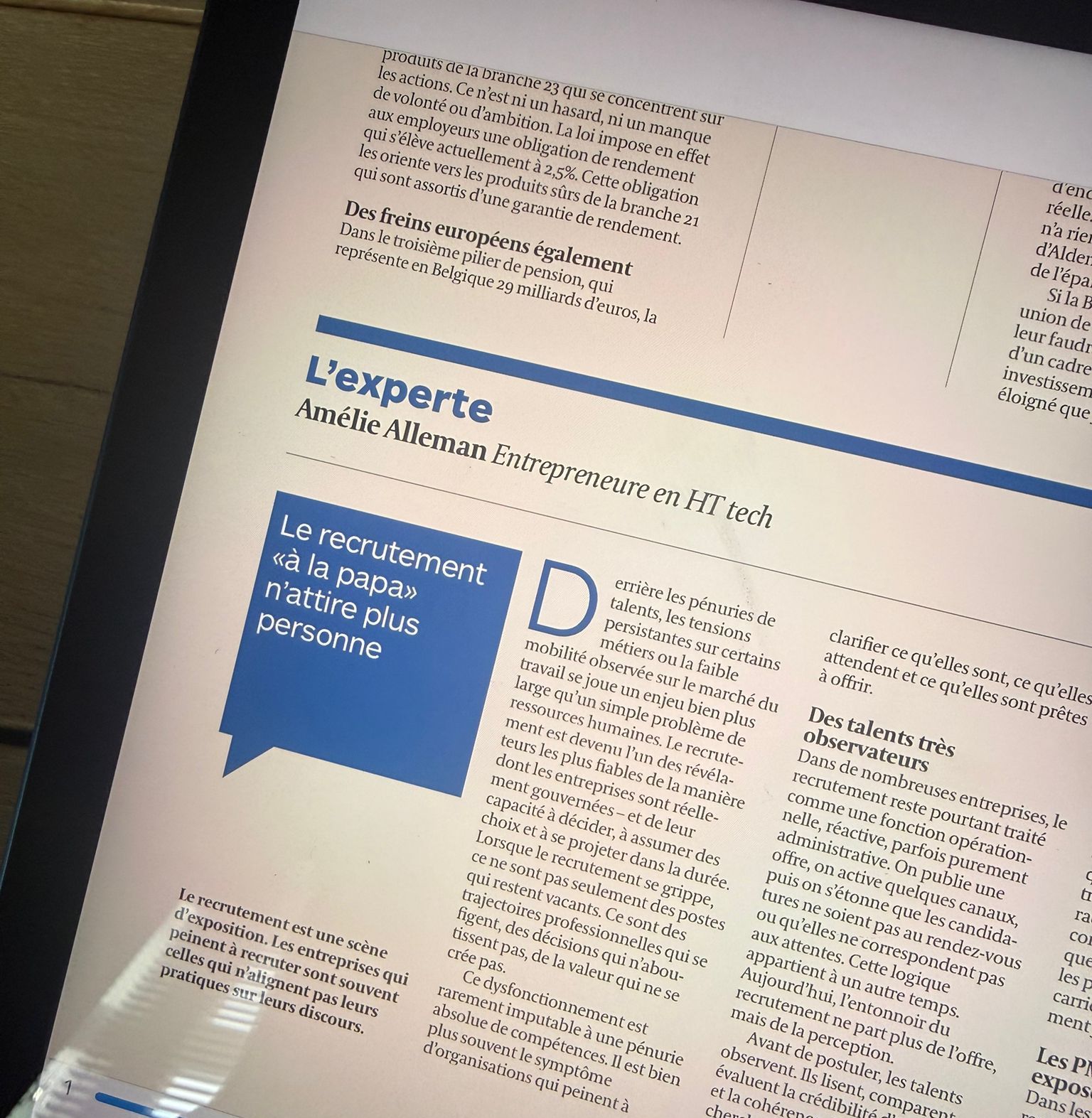
Le recrutement à papa ne recrute plus personne, carte blanche dans l’Echo
Le recrutement est une scène d'exposition. Les entreprises qui peinent à recruter sont souvent celles qui n'alignent pas leurs pratiques sur leurs discours.Derrière les pénuries de talents, les tensions persistantes sur certains métiers ou la faible mobilité observée sur le marché du travail se joue un enjeu bien plus large qu'un simple problème de ressources humaines. Le recrutement est devenu l'un des révélateurs les plus fiables de la manière dont les entreprises sont réellement gouvernées - et de leur capacité à décider, à assumer des choix et à se projeter dans la durée. Lorsque le recrutement se grippe, ce ne sont pas seulement des postes qui restent vacants. Ce sont des trajectoires professionnelles qui se figent, des décisions qui n'aboutissent pas, de la valeur qui ne se crée pas.Ce dysfonctionnement est rarement imputable à une pénurie absolue de compétences. Il est bien plus souvent le symptôme d'organisations qui peinent à clarifier ce qu'elles sont, ce qu'elles attendent et ce qu'elles sont prêtes à offrir.Des talents très observateursDans de nombreuses entreprises, le recrutement reste pourtant traité comme une fonction opérationnelle, réactive, parfois purement administrative. On publie une offre, on active quelques canaux, puis on s'étonne que les candidatures ne soient pas au rendez-vous ou qu'elles ne correspondent pas aux attentes. Cette logique appartient à un autre temps. Aujourd'hui, l'entonnoir du recrutement ne part plus de l'offre, mais de la perception.Avant de postuler, les talents observent. Ils lisent, comparent, évaluent la crédibilité d'un projet et la cohérence d'un discours. Ils cherchent à comprendre comment les décisions sont prises, quel est le rapport au pouvoir, à l'autonomie, à la responsabilité. Autrement dit, ils évaluent la gouvernance, bien avant de se prononcer sur un poste.Cette réalité apparaît de manière particulièrement nette dans l'expérience candidat. Délais de réponse, clarté du processus, qualité des échanges, capacité à trancher: chaque interaction raconte quelque chose de très concret sur l'entreprise. Bien plus que les discours institutionnels ou les promesses affichées sur un site carrière. L'expérience vécue ne ment jamais.Les PME davantage exposéesDans les PME en particulier, où les responsabilités sont concentrées et les circuits courts, le recrutement agit comme un miroir grossissant. C'est souvent à ce moment précis que les candidats comprennent ce que signifie réellement travailler dans cette organisation: où se situent les zones de flou, comment l'arbitrage s'opère, quelle place est accordée à la confiance et à l'initiative. Le recrutement n'est donc pas un simple sas d'entrée. C'est une scène d'exposition. Et comme toute scène, elle ne pardonne ni l'improvisation ni l'incohérence. Les entreprises qui peinent à recruter sont souvent celles qui peinent à décider, à prioriser et à aligner leurs pratiques sur leurs discours.Chaque interaction avec les talents raconte quelque chose de très concret sur l'entreprise. L'expérience vécue ne ment jamais.À l'inverse, celles qui prennent de l'avance ont compris que recruter n'est ni une addition d'outils ni une succession de bonnes pratiques. C'est un système cohérent, aligné sur une manière de diriger. Elles ne cherchent pas à attirer tout le monde. Elles assument ce qu'elles sont, ce qu'elles ne sont pas et ce qu'elles ne veulent plus être.Car recruter n'est jamais un acte neutre. C'est accepter certaines compétences, en écarter d'autres, ouvrir ou fermer des trajectoires. À force d'hésitations et de demi-mesures, le recrutement « à la papa » finit par ne plus recruter personne. À l'inverse, un recrutement clair, exigeant et assumé dit quelque chose d'essentiel: l'entreprise sait décider - et elle sait où elle va.Amélie Alleman - Carte blanche publiée dans L'Echo - 27 février 2026

Leonidas : Renforcer la marque employeur et recruter à l’international
Leonidas: Strengthening the employer brand and recruiting internationallyLeonidas, an iconic Belgian confectionery brand, needed to structure its recruitment in order to meet specific challenges related to its international expansion. By working with Jobloom, the company successfully strengthened its employer brand and attracted qualified talent from across Europe. Discover how we contributed to their success.The challengeInternational recruitmentAttract diverse profiles in different European countries.Lack of visibilityDifficulty effectively promoting job opportunities.Application managementComplex and poorly structured follow-up.The objectivesCreate a careers site to showcase your employer brand and centralize job openings.Implement an efficient ATS to streamline application management.Develop an international recruitment strategytailored to their specific needs.The solution provided by JobloomA tailor-made careers site: A dedicated space presenting Leonidas as an employer of choice, highlighting its values and opportunities.An applicant tracking system (ATS): Centralized and simplified tracking for all job postings across Europe.Visibility optimization: Multi-posting of job ads to maximize their reach on European job boards and social networks.Request a free demo

Comment Huggys a multiplié par 12 son taux de conversion candidat dans l’hospitalité ?
How Huggys multiplied its candidate conversion rate by 12 in the hospitality sectorDiscover how Huggys, a player in the hospitality sector, revolutionized its recruitment thanks to Jobloom. With a 24% conversion rate and 400 resumes received per month, our solution has transformed their HR strategy. -- With high turnover and a lack of digitalization, Huggys, a company specializing in the hospitality sector, was facing major recruitment challenges. By working with Jobloom, Huggys was able to structure and optimize its recruitment process while developing its employer brand. Find out how our solution transformed their HR strategy.The challengeHuggys was facing several obstacles:High turnover: A constant need to recruit new talent.Outdated processes: Lack of appropriate tools and digital solutions.Lack of visibility: An employer brand that is not sufficiently highlighted, making it difficult to attract talent.The objectivesStructure the recruitment processwith a dedicated tool.Create an attractive careers siteto strengthen your employer brand.Improve application managementthanks to an intuitive digital system.The solution provided by JobloomCreation of a customized careers site: Showcasing the Huggys brand to attract talent, with a clear presentation of the company’s values and opportunities.Applicant Tracking System (ATS): Centralized tracking of applications to streamline the selection and hiring of top candidates.Optimization of the recruitment process: Full digitalization for time savings and increased efficiency.The results📌 A conversion rate 12 times higher than average! The average conversion rate for career sites in the hospitality and restaurant industry is around 2% to 3% (source: LinkedIn & Glassdoor). With 24%, Huggys vastly outperforms the market thanks to optimizing its recruitment through Jobloom.Want to transform your recruitment like Huggys?Discover how Jobloom can help you tackle your HR challenges with a tailor-made solution.Request a free demo
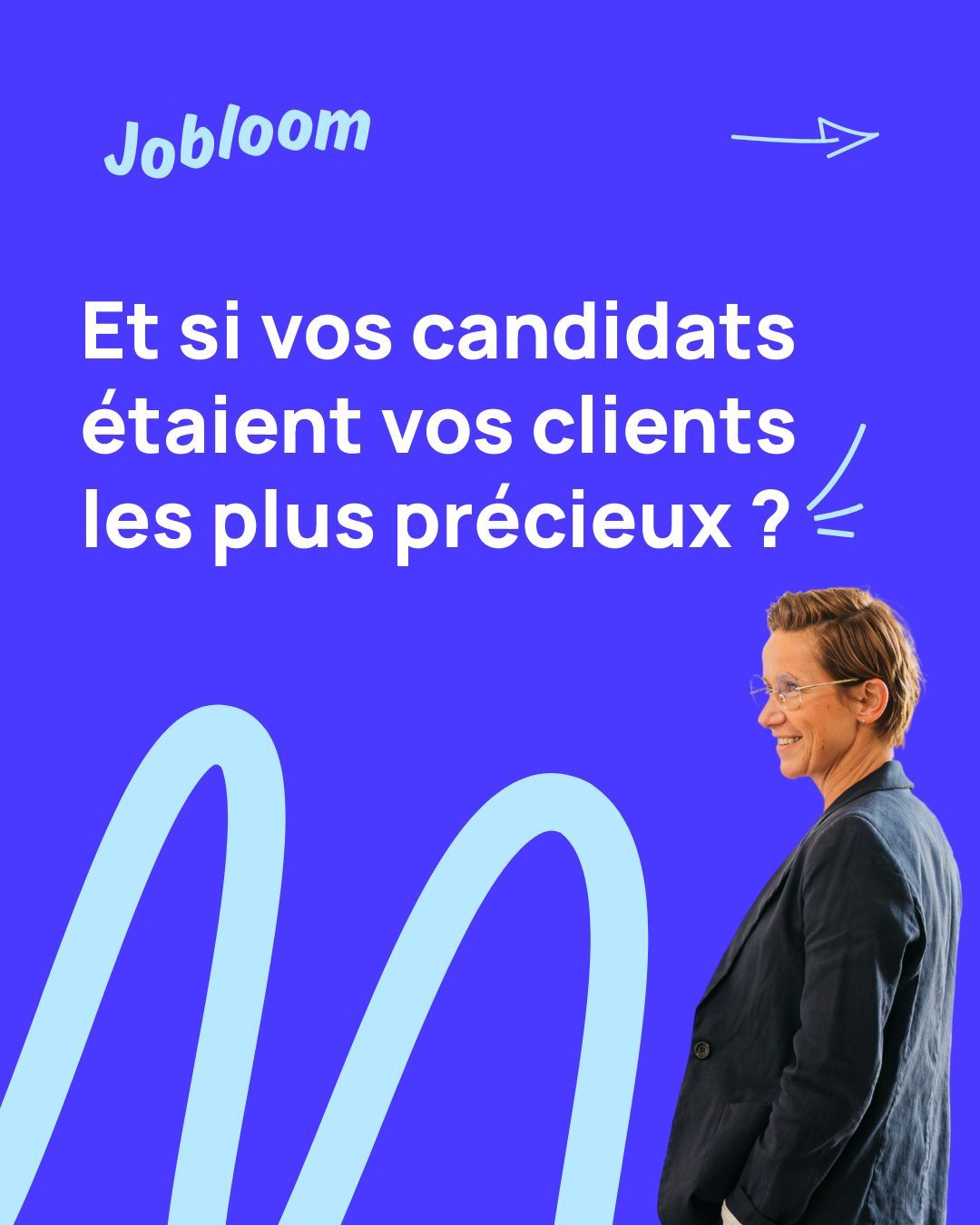
Et si vos candidats étaient vos clients les plus précieux ?
#1 Talents = Clients 55 % refusent une offre à cause d’un mauvais processus. 50 % se disent déçus de leur expérience candidat. Pourtant, vous bichonnez vos clients. Pourquoi pas vos talents ?#2 RecruterRecruter, ce n’est plus filtrer. C’est séduire, comme une vraie marque. Les candidats veulent une expérience claire, fluide, engageante.#3 Site carrière personnaliséMobile, fluide, à votre image. Jusqu’à 24 % de conversion.#4 Diffusion sur 100+ plateformes Automatiquement. Google job, Indeed, LinkedIn Recruteur… en un clic.#5 Un ATS boosté à l’IACentralisez vos candidatures, automatisez, gagnez du temps.#6 Le recrutements devient simpleLes bons candidats viennent à vous. Et ils ont envie de rester.#7 Vos candidats ne sont pas des numérosCe sont vos futurs clients internes. Et avec Jobloom, vous les recrutez comme vous vendez.La bonne nouvelle ? Tout ça se corrige facilement.Avec Jobloom, les PME peuvent digitaliser leur recrutement sans perdre leur authenticité et sans se ruiner.Vous avez envie de voir comment ça marche ?
You might also like
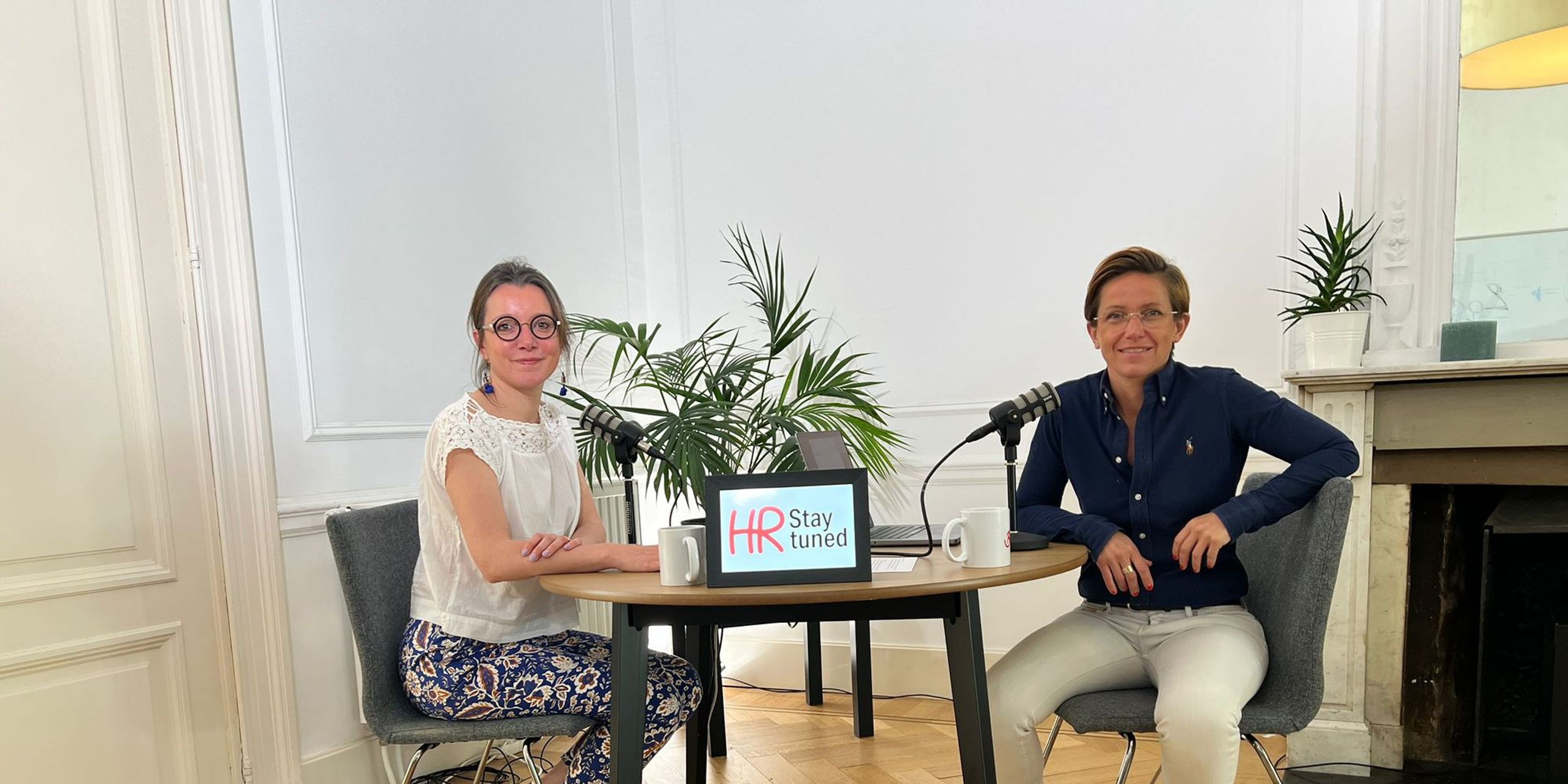
Employer branding: stop selling dreams, let your employees tell the real story.
Is your employer brand lacking authenticity? Stop selling dreams and find out how to turn your employees into your best ambassadors.There's a scene I see all too often. A company spends a fortune on a beautiful recruitment campaign. Sleek visuals, inspiring slogans, promises of fulfillment... on paper, it's perfect. But internally, employees roll their eyes. Sometimes they laugh. Sometimes they're just cynical.This gap, this wide discrepancy between the storefront and the back office, is the silent cancer of the employer brand.During my recent conversation with Anne-Sophie Noël, whom I had the pleasure of interviewing in episode 32 of the HR Stay Tuned podcast, she pointed out a painful truth with a candor that struck me: "If there's a discrepancy between what a company says about itself in external communications, its ambassadors, that is its employees, will very quickly say: 'No, no, no, that's bullshit, it's not exactly like that.'""Bullshit". The word is out. And it's accurate.In an era where trust is such a rare currency, it's time to stop this corporate charade. Let's stop selling dreams. Let's start sharing reality.The credibility crisis: why no one believes in your stock photos anymoreThe problem is not new. In fact, it's the topic I covered in my final thesis: the alignment between internal and external communication. Even back then, it was clear to me. And today, the phenomenon is amplified by a radical transparency imposed by the digital world.Your candidates are not naive. Even before applying, they have already conducted their research on social media, or by contacting former employees. They know. And the numbers confirm it. According to a study by LinkedIn Talent Solutions, candidates trust employees of a company three times more than the company itself to get credible information about the work environment.Three times.Reread this statistic. It marks the death certificate of top-down and sanitized corporate communication. The career site with actors smiling around a coffee machine? No one believes it. The CEO's polished speech on "values"? It is immediately contrasted with the stories, good or bad, that the teams share on the ground.As Anne-Sophie aptly puts it, your true ambassadors are not your PR agencies. " The employees of a company are its first ambassadors. " They are your only source of truth. Ignoring them, or worse, contradicting them, is not just a mistake. It's brand suicide.The authenticity revolution: co-creating your story, not making it upSo, what do we do? Do we give up?On the contrary. We are radically changing paradigms. The solution is disarmingly simple, but it requires courage: we must make authenticity a strategy.Anne-Sophie summed it up perfectly: "A good employer branding campaign, to me, is one that is done with the employees."This goes well beyond a few scripted video testimonials. It's about co-creating your story. This is called "Employee Advocacy", but let's get rid of the jargon. In plain terms, it's about creating an environment where your teams are not only heard, but also feel proud and safe to share their actual experiences.How do we do it, practically speaking?Listen before you speak: What do your colleagues REALLY like about you? What excites them? What frustrates them? Conduct surveys, focus groups, informal conversations. Look for the raw material, not the polish.Identify your true storytellers: Give a voice to everyone. Not just to managers or the "good students". Highlight the technician who solves complex problems, the accountant who loves the atmosphere of her team, the young talent who has been well integrated. Their experiences are a thousand times more powerful than any slogan.Provide them with a stage, not a script: Your career site should be their platform. Your LinkedIn account should showcase their achievements. Companies like Patagonia or Decathlon don't burden themselves with corporate speak; they show their employees in action, living the passion for sports or the outdoors that is the brand's DNA. According to a report by MSLGroup, messages shared by employees have a reach 561% greater than the same messages shared through the brand's official channels. It's a monumental marketing and HR lever, based on trust.My struggle: to make authenticity accessibleI have held this belief for years. It's what recently drove me to launch Jobloom, my new venture. I've seen too many companies wanting to be authentic, but facing a lack of time or budget to create quality content.My obsession is to make this authenticity 'sexy' and accessible. As I was explaining to Anne-Sophie, we directly integrate the creation of this lively and embodied content into the design of career websites. We help companies to interview their talents, to turn these gems into captivating stories, so that their employer brand can finally be a true and attractive reflection of their culture.Because in the end, the best employer brand isn't the one that promises the moon. It's the one that tells you: "This is who we are, with our strengths, our challenges, and the incredible people who keep things running. If that speaks to you, join us."It's an invitation, not an advertisement. And that's the whole difference.

Corporate Culture: The Secret to an Irresistible Employer Brand
Forget foosball. A strong employer brand isn't what you promise, but what you are. Discover how to make your company culture your greatest asset.In a job market where attracting and retaining talent has become an art, corporate culture is no longer a mere "nice-to-have" option. It's the foundation, the DNA upon which an employer brand that is authentic and, dare we say, irresistible is built. But how do we move from nice words on a poster to a reality that is lived and embodied by every employee?To decipher this fascinating topic, we had the pleasure of discussing with Barbara Vandermaesen, co-founder of the consulting firm Humind, in our latest podcast. With her experience as a consultant and HR director, she provided us with valuable insights on how to build a culture that not only attracts but also makes people want to stay.Let's discover together the secrets to making your culture the most powerful of your assets.What is Corporate Culture, Concretely?Forget the academic definitions. Barbara offers us a much more evocative metaphor: imagine entering a house. Before even seeing the details, you feel an atmosphere. It's the smell, the warmth, the soul of the place. The corporate culture, that's exactly what it is."It's that soul, that smell, that atmosphere that is created within the organization. [...] It's something that you feel." - Barbara VandermaesenA strong culture is not one where everyone thinks the same. It's a consistent culture. It's when the experience you have, whether as a candidate, employee, or customer, is the same at every touchpoint. From the wallpaper on Teams to the onboarding, including the way successes are celebrated.The 4 Pillars of a Living and High-Performing CultureSo, how do we build this consistency? According to Humind, it all rests on a pragmatic four-dimensional model. To omit any one of them is to risk seeing your beautiful cultural edifice collapse.1. The Expression: Communicating Your DNAThis is the most visible part. It's about defining and clearly communicating who you are.Define your values: What do they actually mean to you?Create a manifesto: Share your story, your "why".Deploy a communication plan: Use all channels (intranet, posters, meetings) to ensure the message is heard.But beware, this is only the beginning. A culture that remains at the stage of expression is an empty shell.2. Modeling: Embodying BehaviorsA value like "innovation" is good. But what does it mean in everyday life?Translate values into observable behaviors: Does "Innovate" mean "having the right to make mistakes"? "Suggesting ideas outside of one's scope"?Leading by example: Managers and executives must be the first to embody these behaviors. If you advocate for collaboration, but the leaders work in silos, the message gets mixed.Train and support: Help your teams understand and adopt these new habits.3. Anchoring: Aligning Your HR ProcessesThis is where the magic happens (or not!). Your culture should permeate all of your organizational processes, especially your HR levers.Recruitment: Does your hiring process reflect your values? Are the interview questions aligned?Onboarding : Welcoming new members is a crucial moment to convey the culture.Performance Management: Do you assess and reward the behaviors you want to promote?Internal communication: Your intranet, newsletters, events... everything should reflect your culture.4. Empathy: Taking the Pulse of Your OrganizationOne can only improve what one measures. To know if your culture truly lives, one must listen.Quantitative surveys: Regular polls to measure adherence to values and the social climate.Qualitative approach: Interviews, focus groups, workshops to understand the nuances.Observation: Pay attention to the weak signals, the informal rituals, and what is said around the coffee machine.By working on these four dimensions in a balanced way, you create a virtuous circle where the culture is continuously strengthened.From Culture to Recruitment: Culture Fit or Culture Add?This is a strategic question that every human resources professional should ask themselves. Should we recruit people who are like us (Culture Fit) or people who complement us (Culture Add)?Culture Fit: It's the path of comfort. We recruit "clones" who integrate easily. The risk? Groupthink, stagnation, and reduced adaptability.The Culture Add: It's the path to evolution. We hire diverse profiles that bring new perspectives and challenge the status quo. It's essential for innovation, but it requires a greater integration effort to ensure the individual doesn't feel like an "alien".The right answer depends on your maturity and your HR strategy. What's important is to consciously make this choice: are we looking to strengthen our current culture or to evolve it?Showcasing Your Culture: Employer Branding in ActionOnce your culture is defined, embodied, and established, it's time to make it shine to attract the talents that match you.Authenticity above all: Your employer brand should be a true reflection of your internal reality. False promises create disappointments that are costly in terms of turnover and reputation.Internal-External Coherence: The message conveyed on your career site, in your videos, or on Glassdoor must be aligned with the employee experience. Any discrepancy is quickly noticed and harms your credibility.Les Ambassadeurs, vos meilleurs alliés : Le leadership est le premier ambassadeur. Mais ne vous arrêtez pas là ! Identifiez des collaborateurs à tous les niveaux qui incarnent votre culture et donnez-leur les moyens de la partager. Comme le suggère Barbara, pourquoi ne pas les impliquer dans l'onboarding des nouveaux arrivants ? C'est une manière incroyablement puissante de transmettre l'ADN de l'entreprise dès le premier jour.In ConclusionBuilding a strong corporate culture and an irresistible employer brand is not a sprint, but a marathon. It requires strategy, consistency, listening, and unwavering commitment from leadership.True success is when culture is no longer an "HR project" but everyone's business. It's when every interaction, every process, every communication reinforces who you are. That's how you will not only create a competitive edge to attract the best, but also a work environment where well-being and commitment lead to sustained performance.And you, where are you in building your culture? What are your biggest challenges? Share your experience in the comments!