The digitization of recruitment has become essential for SMEs. This article explains how to:
- Offer a fluid and mobile-first candidate experience.
- Use your employer brand as a lever for attraction.
- Avoid fragmented processes thanks to a centralized database.
- Automate repetitive tasks to save time.
- Effectively disseminate your job offers.
- Improve internal collaboration around recruitment.
Why digitize recruitment?
Everything has become digital. We buy in a few clicks on Amazon, we book our holidays on our smartphone... and candidates expect the same simplicity when applying for a job.
The parallel with e-commerce is striking: nearly 3 out of 5 buyers abandon their online cart before finalizing.
In digital recruitment, it's even worse. If the process is not fluid and mobile-friendly, you lose your talent before you even meet them.
A classic career site converts only 0 to 2% of its visitors into candidates, whereas with an optimized digital experience (SEO, employer brand content, mobile first), this rate can be multiplied by 10, creating a genuine source of candidate acquisition.
Digitizing recruitment has become a vital issue for any SME that needs talent.
Digitizing recruitment with a simple candidate conversion funnel
Just like in marketing, you need to think about the conversion funnel. A candidate must be guided from where they are (Google Jobs, LinkedIn, social networks, articles, specialized job boards...) to the application stage.
The 3 key steps:
- Be present where candidates are.
- Offer a friction-free experience, especially on mobile (more than 90% of applications are made on smartphones).
- Allow applying in one click, via a CV or a LinkedIn profile.
Did you know that 90% of LinkedIn users in Belgium are exclusively on mobile?
Using your employer brand
Why would a candidate choose your SME over another company with an equivalent position and salary? The answer lies in your employer brand.
This must be authentic. Forget the “bullshit” and the nice marketing speeches: you have to speak the truth.
Questions to ask yourself:
- What is your work culture?
- What are your values and vision?
- What concrete projects are your teams leading?
- What opportunities for growth or training do you offer?
84% of candidates look for information about the employer brand before applying, and this figure rises even higher for shortage profiles.
An empty or outdated career site becomes a major obstacle.
Also, remember to adapt your content according to your target profiles: a worker, an engineer, or an IT specialist will not have the same expectations or language.
Avoid fragmented processes
Too many SMEs still manage their recruitment via a mixture of emails, Excel, Dropbox, or SharePoint. The result: fragmented and inefficient processes.
Concrete examples:
- A candidate already met is contacted again by mistake.
- A promising profile is lost due to the lack of a centralized database.
- Candidate feedback is forgotten, tarnishing the employer image.
A centralized database
The key to digitization is data centralization.
With an ATS (Applicant Tracking System), you create a unique database that:
- Keeps the history of each candidate,
- Shares information between managers,
- Allows building a talent pool for future recruitments,
- Simplifies the rejection or automated follow-up of applications.
Thus, no more information loss and instant access to your talent, even those met in the past.
Digitizing recruitment by automating time-consuming tasks
The goal is not to replace the human, but to free up time.
Automation reduces operational tasks to focus on what matters: the human encounter.
Examples of useful automation:
- Automatic creation of candidate profiles (CV reading, skills, languages, etc.).
- Sending automated and personalized rejections.
- Follow-ups of old applications.
- CV sorting with extraction of key skills.
- Qualification via short forms.
- Automatic generation of ads, translations, and social media content.
- Automated multi-platform dissemination.
With AI, these steps become even more fluid and precise.
Automated dissemination of job offers
Publishing on LinkedIn, Indeed, or Google Jobs seems simple, but it is time-consuming.
Candidates are scattered across multiple channels, so you need to disseminate effectively across multiple platforms.
Thanks to multi-dissemination tools, an ad can be published with one click on all relevant channels.
Advantages:
- Considerable time saving.
- Maximum visibility among the right candidates.
- Complete coverage of the job market without extra effort.
Facilitate internal communication
Recruitment is never done alone. In an SME, several actors are involved: directors, managers, HR...
Without a central tool, communication becomes fragmented.
The benefits of a centralized tool:
- Notes and evaluations directly on the candidate profile.
- Real-time tracking of recruitment efforts.
- Documented and transparent decisions.
Result: a more collaborative, fast, and clear process — a guarantee of professionalism towards candidates.
Conclusion: digitizing recruitment, a necessity for SMEs
Not digitizing your recruitment means losing your candidates before you even meet them.
In summary:
- A mobile-first and fluid candidate experience.
- An authentic and visible employer brand.
- A centralized and smart database.
- Automated processes to focus on the human element.
Digitizing recruitment means putting the human element back at the center.
The latest
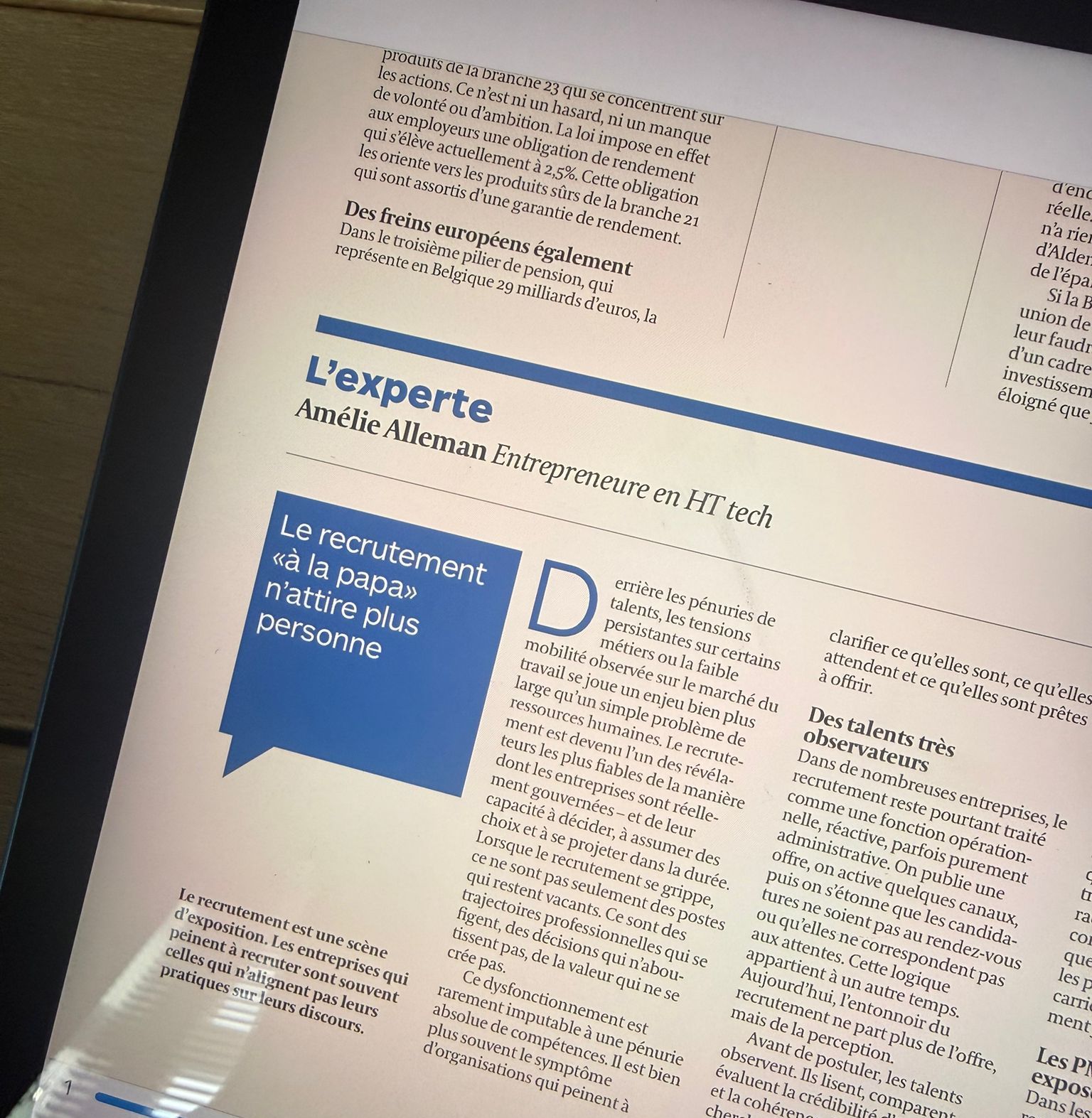
Le recrutement à papa ne recrute plus personne, carte blanche dans l’Echo
Le recrutement est une scène d'exposition. Les entreprises qui peinent à recruter sont souvent celles qui n'alignent pas leurs pratiques sur leurs discours.Derrière les pénuries de talents, les tensions persistantes sur certains métiers ou la faible mobilité observée sur le marché du travail se joue un enjeu bien plus large qu'un simple problème de ressources humaines. Le recrutement est devenu l'un des révélateurs les plus fiables de la manière dont les entreprises sont réellement gouvernées - et de leur capacité à décider, à assumer des choix et à se projeter dans la durée. Lorsque le recrutement se grippe, ce ne sont pas seulement des postes qui restent vacants. Ce sont des trajectoires professionnelles qui se figent, des décisions qui n'aboutissent pas, de la valeur qui ne se crée pas.Ce dysfonctionnement est rarement imputable à une pénurie absolue de compétences. Il est bien plus souvent le symptôme d'organisations qui peinent à clarifier ce qu'elles sont, ce qu'elles attendent et ce qu'elles sont prêtes à offrir.Des talents très observateursDans de nombreuses entreprises, le recrutement reste pourtant traité comme une fonction opérationnelle, réactive, parfois purement administrative. On publie une offre, on active quelques canaux, puis on s'étonne que les candidatures ne soient pas au rendez-vous ou qu'elles ne correspondent pas aux attentes. Cette logique appartient à un autre temps. Aujourd'hui, l'entonnoir du recrutement ne part plus de l'offre, mais de la perception.Avant de postuler, les talents observent. Ils lisent, comparent, évaluent la crédibilité d'un projet et la cohérence d'un discours. Ils cherchent à comprendre comment les décisions sont prises, quel est le rapport au pouvoir, à l'autonomie, à la responsabilité. Autrement dit, ils évaluent la gouvernance, bien avant de se prononcer sur un poste.Cette réalité apparaît de manière particulièrement nette dans l'expérience candidat. Délais de réponse, clarté du processus, qualité des échanges, capacité à trancher: chaque interaction raconte quelque chose de très concret sur l'entreprise. Bien plus que les discours institutionnels ou les promesses affichées sur un site carrière. L'expérience vécue ne ment jamais.Les PME davantage exposéesDans les PME en particulier, où les responsabilités sont concentrées et les circuits courts, le recrutement agit comme un miroir grossissant. C'est souvent à ce moment précis que les candidats comprennent ce que signifie réellement travailler dans cette organisation: où se situent les zones de flou, comment l'arbitrage s'opère, quelle place est accordée à la confiance et à l'initiative. Le recrutement n'est donc pas un simple sas d'entrée. C'est une scène d'exposition. Et comme toute scène, elle ne pardonne ni l'improvisation ni l'incohérence. Les entreprises qui peinent à recruter sont souvent celles qui peinent à décider, à prioriser et à aligner leurs pratiques sur leurs discours.Chaque interaction avec les talents raconte quelque chose de très concret sur l'entreprise. L'expérience vécue ne ment jamais.À l'inverse, celles qui prennent de l'avance ont compris que recruter n'est ni une addition d'outils ni une succession de bonnes pratiques. C'est un système cohérent, aligné sur une manière de diriger. Elles ne cherchent pas à attirer tout le monde. Elles assument ce qu'elles sont, ce qu'elles ne sont pas et ce qu'elles ne veulent plus être.Car recruter n'est jamais un acte neutre. C'est accepter certaines compétences, en écarter d'autres, ouvrir ou fermer des trajectoires. À force d'hésitations et de demi-mesures, le recrutement « à la papa » finit par ne plus recruter personne. À l'inverse, un recrutement clair, exigeant et assumé dit quelque chose d'essentiel: l'entreprise sait décider - et elle sait où elle va.Amélie Alleman - Carte blanche publiée dans L'Echo - 27 février 2026

Leonidas : Renforcer la marque employeur et recruter à l’international
Leonidas: Strengthening the employer brand and recruiting internationallyLeonidas, an iconic Belgian confectionery brand, needed to structure its recruitment in order to meet specific challenges related to its international expansion. By working with Jobloom, the company successfully strengthened its employer brand and attracted qualified talent from across Europe. Discover how we contributed to their success.The challengeInternational recruitmentAttract diverse profiles in different European countries.Lack of visibilityDifficulty effectively promoting job opportunities.Application managementComplex and poorly structured follow-up.The objectivesCreate a careers site to showcase your employer brand and centralize job openings.Implement an efficient ATS to streamline application management.Develop an international recruitment strategytailored to their specific needs.The solution provided by JobloomA tailor-made careers site: A dedicated space presenting Leonidas as an employer of choice, highlighting its values and opportunities.An applicant tracking system (ATS): Centralized and simplified tracking for all job postings across Europe.Visibility optimization: Multi-posting of job ads to maximize their reach on European job boards and social networks.Request a free demo

Comment Huggys a multiplié par 12 son taux de conversion candidat dans l’hospitalité ?
How Huggys multiplied its candidate conversion rate by 12 in the hospitality sectorDiscover how Huggys, a player in the hospitality sector, revolutionized its recruitment thanks to Jobloom. With a 24% conversion rate and 400 resumes received per month, our solution has transformed their HR strategy. -- With high turnover and a lack of digitalization, Huggys, a company specializing in the hospitality sector, was facing major recruitment challenges. By working with Jobloom, Huggys was able to structure and optimize its recruitment process while developing its employer brand. Find out how our solution transformed their HR strategy.The challengeHuggys was facing several obstacles:High turnover: A constant need to recruit new talent.Outdated processes: Lack of appropriate tools and digital solutions.Lack of visibility: An employer brand that is not sufficiently highlighted, making it difficult to attract talent.The objectivesStructure the recruitment processwith a dedicated tool.Create an attractive careers siteto strengthen your employer brand.Improve application managementthanks to an intuitive digital system.The solution provided by JobloomCreation of a customized careers site: Showcasing the Huggys brand to attract talent, with a clear presentation of the company’s values and opportunities.Applicant Tracking System (ATS): Centralized tracking of applications to streamline the selection and hiring of top candidates.Optimization of the recruitment process: Full digitalization for time savings and increased efficiency.The results📌 A conversion rate 12 times higher than average! The average conversion rate for career sites in the hospitality and restaurant industry is around 2% to 3% (source: LinkedIn & Glassdoor). With 24%, Huggys vastly outperforms the market thanks to optimizing its recruitment through Jobloom.Want to transform your recruitment like Huggys?Discover how Jobloom can help you tackle your HR challenges with a tailor-made solution.Request a free demo
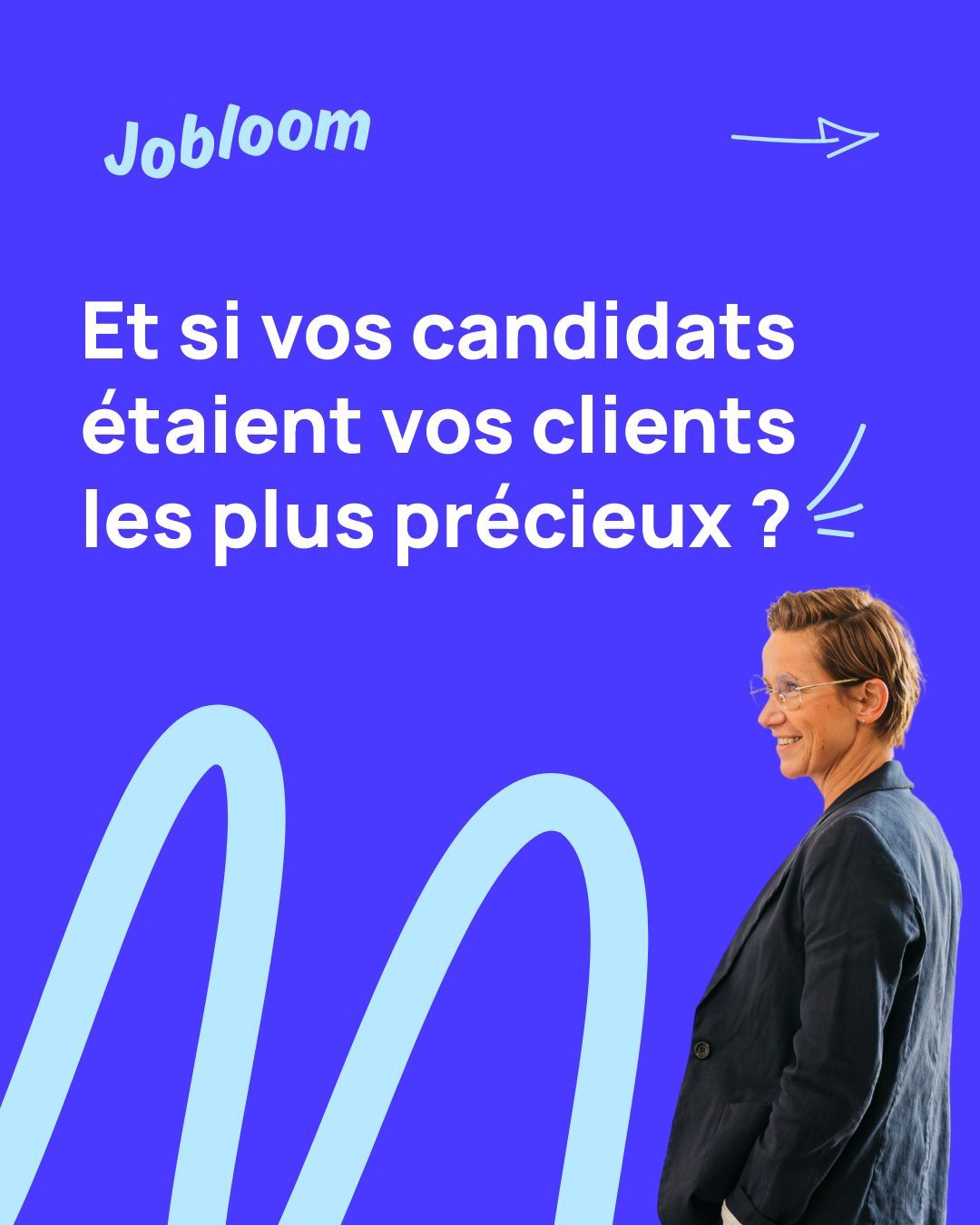
Et si vos candidats étaient vos clients les plus précieux ?
#1 Talents = Clients 55 % refusent une offre à cause d’un mauvais processus. 50 % se disent déçus de leur expérience candidat. Pourtant, vous bichonnez vos clients. Pourquoi pas vos talents ?#2 RecruterRecruter, ce n’est plus filtrer. C’est séduire, comme une vraie marque. Les candidats veulent une expérience claire, fluide, engageante.#3 Site carrière personnaliséMobile, fluide, à votre image. Jusqu’à 24 % de conversion.#4 Diffusion sur 100+ plateformes Automatiquement. Google job, Indeed, LinkedIn Recruteur… en un clic.#5 Un ATS boosté à l’IACentralisez vos candidatures, automatisez, gagnez du temps.#6 Le recrutements devient simpleLes bons candidats viennent à vous. Et ils ont envie de rester.#7 Vos candidats ne sont pas des numérosCe sont vos futurs clients internes. Et avec Jobloom, vous les recrutez comme vous vendez.La bonne nouvelle ? Tout ça se corrige facilement.Avec Jobloom, les PME peuvent digitaliser leur recrutement sans perdre leur authenticité et sans se ruiner.Vous avez envie de voir comment ça marche ?

Amélie Alleman
Founder of Jobloom and Betuned, Amélie Alleman is a passionate entrepreneur who has been shaking up the recruitment industry for over 15 years. She innovates at the crossroads of communication, digital marketing and technology to make recruitment more human and tailored to the expectations of today's talent. Her solutions now support both start-ups and large groups in their HR transformation.