
Automation is no longer enough. From predictive AI to skill platforms, discover 5 tech trends that put humans at the heart of HR strategy.
For many HR leaders, technology has long been synonymous with automation: payroll management, leave tracking, resume sorting. These optimizations, while necessary, are just the tip of the iceberg. The real revolution, the one that is unfolding today, is strategic in nature.
Artificial intelligence, data analysis, and smart platforms are no longer just about performing tasks. They enhance our decision-making abilities, allow us to understand human dynamics with unprecedented depth, and transform the HR function from an administrative cost center into a driver of performance and growth for the company.
This article does not merely list innovations. It provides you with a roadmap to understand how these trends will impact your core missions: attracting the best, developing their potential, and building resilient organizations.
1. From the Resume to Data: Recruitment Enhanced by AI
Yesterday, recruitment was based on the analysis of a resume and the recruiter's intuition. Tomorrow, it will be a predictive science based on a multitude of data points. Technology does not replace human judgment; it enhances it by providing a holistic and objective view of the candidates.
How does it work?
Modern AI algorithms go well beyond simple keyword filtering. They can:
- Analyzing cross-functional skills: By cross-referencing information from a LinkedIn profile, an online portfolio, and responses to situational exercises, AI can identify soft skills such as problem-solving or leadership abilities.
- Assessing Cultural Fit: Through semantic analysis of written or video responses, tools can evaluate a candidate's alignment with the company's values and operating mode, thereby reducing casting errors.
- Predicting performance: By modeling the paths of the most successful employees, these systems can identify external profiles that exhibit the same markers of potential success.
The goal: Reduce unconscious biases, speed up the selection process and, above all, drastically increase the success rate of hiring by focusing on actual potential rather than a linear career path.
2. Predictive Analysis: Anticipating Disengagement to Better Retain
The cost of an employee's departure is colossal, both financially and organizationally. Instead of reacting to a resignation, the most advanced HR technology now allows for proactive action. Predictive analysis is your best ally in transforming retention into a proactive strategy.
Identify weak signals
By analyzing anonymized and aggregated diverse data, HR platforms can detect patterns that are precursors to disengagement:
- Decrease in participation in internal communications.
- Fewer collaborations on cross-functional projects.
- Changes in the patterns of connection or use of the company's tools.
Concrete example: A system could alert an HR manager that a high-potential employee, whose performance is stable, has stopped participating in optional training programs and is interacting less on team channels. This is a subtle signal that invites starting a conversation well before the situation becomes critical. The company can then offer a new project, targeted training, or an adjustment of their tasks.
3. The Hyper-Personalization of Continuing Education through AI
The era of the "training catalog for everyone" is over. In an environment where skills quickly become obsolete, learning agility is key. AI transforms training into a continuous, personalized experience that is integrated into the daily life of the employee.
Custom development paths
AI-powered Learning Experience Platforms (LXP) do more than just suggest content. They create dynamic career paths.
- Skills gap analysis: The tool compares an employee's current skills (derived from their evaluations, projects) with those required for their next role or for the company's future strategic needs.
- Contextual recommendations: The platform then offers micro-learning sessions, articles, podcasts, or connections with internal mentors, at the exact moment the need arises.
Some companies take the concept further with virtual coaches who help employees set their career goals and offer them tailored resources in real-time, enhancing their autonomy and engagement.
4. The End of Intuition: Driving HR Strategy with Data and ROI
For years, HR departments have struggled to prove their tangible impact on business outcomes. Data visualization and HR data analysis (People Analytics) are radically changing the game. The HR function can finally speak the language of the executive committee: that of return on investment (ROI).
From data to strategic decision
Technology enables the connection of HR initiatives to key performance indicators (KPIs):
- Measuring recruitment effectiveness: Which sourcing channel brings in candidates who stay the longest and perform the best?
- Assessing the impact of well-being: Is there a correlation between team engagement scores and their business performance?
- Optimizing budgets: Which training program generates the highest increase in productivity?
Thanks to clear and dynamic dashboards, HR managers can justify their investments, adjust their strategies in real time, and demonstrate their essential role in achieving overall objectives.
5. Towards Agile Organizations: Tech at the Service of Collective Performance
The latest disruption, and perhaps the most profound, does not concern the individual but the collective. Technology now provides tools to analyze and optimize the very structure of the organization, promoting agility and innovation.
Mapping social capital
Tools like Organizational Network Analysis (ONA - Organizational Network Analysis) enable the visualization of actual communication and collaboration flows, beyond the formal organizational chart. HR managers can thus:
- Identify informal influencers who are essential for driving change.
- Identify teams working in silos and create bridges to foster innovation.
- Form project teams not on the basis of titles, but on the basis of proven collaborative dynamics.
By using these insights, an HR director can surgically restructure teams to unlock performance, based on tangible data rather than solely on intuition.
From Vision to Action: Make Your HR Strategy a Reality with Jobloom
Understanding these trends is the first step. Implementing them to gain a competitive edge is another. HR digital transformation is not a matter of tools, but of integrated strategy. This is precisely where Jobloom comes in.
We are not just a software provider. We are your strategic partner to make these innovations a tangible reality within your organization.
- Enhanced Recruitment (Points 1 & 4): Our smart ATS and our custom career sites do more than just handle applications. They collect valuable data to help you make informed decisions, measure the ROI of your campaigns, and build a holistic view of your talent.
- An Employer Brand that Attracts and Retains (Point 2): Through our impactful job videos and our Employer Branding consulting, we help you reveal your unique DNA. A strong and authentic culture is the best defense against disengagement.
- A Content Strategy for the Digital Age (Points 3 & 5): We produce expert content that positions your company as a thought leader, naturally attracting talents who share your vision and wish to grow with you.
Ready to transform your HR function into a true growth engine?
Let's plan a strategic exchange to align your vision with the best technologies in the market.
The latest
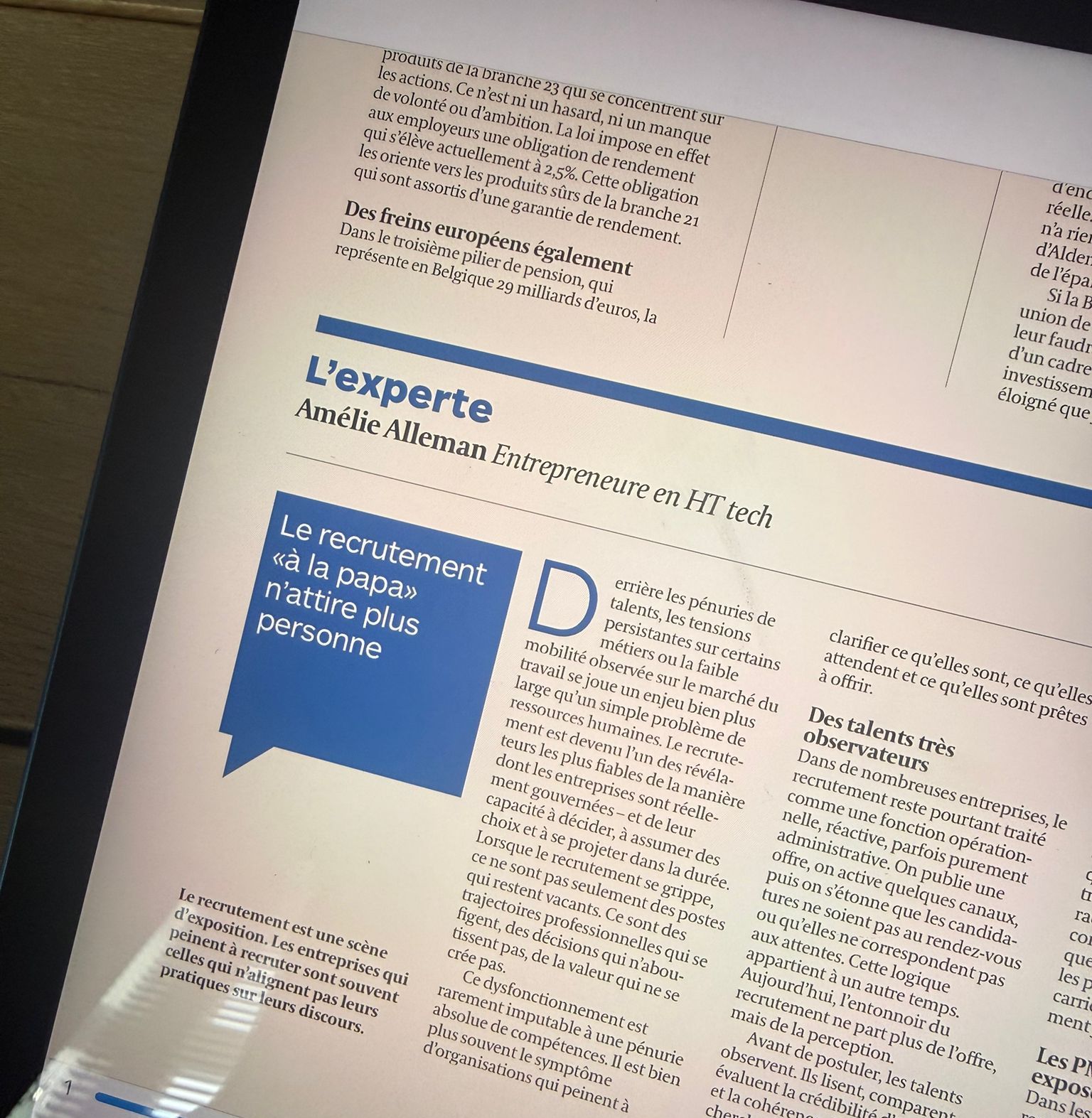
Le recrutement à papa ne recrute plus personne, carte blanche dans l’Echo
Le recrutement est une scène d'exposition. Les entreprises qui peinent à recruter sont souvent celles qui n'alignent pas leurs pratiques sur leurs discours.Derrière les pénuries de talents, les tensions persistantes sur certains métiers ou la faible mobilité observée sur le marché du travail se joue un enjeu bien plus large qu'un simple problème de ressources humaines. Le recrutement est devenu l'un des révélateurs les plus fiables de la manière dont les entreprises sont réellement gouvernées - et de leur capacité à décider, à assumer des choix et à se projeter dans la durée. Lorsque le recrutement se grippe, ce ne sont pas seulement des postes qui restent vacants. Ce sont des trajectoires professionnelles qui se figent, des décisions qui n'aboutissent pas, de la valeur qui ne se crée pas.Ce dysfonctionnement est rarement imputable à une pénurie absolue de compétences. Il est bien plus souvent le symptôme d'organisations qui peinent à clarifier ce qu'elles sont, ce qu'elles attendent et ce qu'elles sont prêtes à offrir.Des talents très observateursDans de nombreuses entreprises, le recrutement reste pourtant traité comme une fonction opérationnelle, réactive, parfois purement administrative. On publie une offre, on active quelques canaux, puis on s'étonne que les candidatures ne soient pas au rendez-vous ou qu'elles ne correspondent pas aux attentes. Cette logique appartient à un autre temps. Aujourd'hui, l'entonnoir du recrutement ne part plus de l'offre, mais de la perception.Avant de postuler, les talents observent. Ils lisent, comparent, évaluent la crédibilité d'un projet et la cohérence d'un discours. Ils cherchent à comprendre comment les décisions sont prises, quel est le rapport au pouvoir, à l'autonomie, à la responsabilité. Autrement dit, ils évaluent la gouvernance, bien avant de se prononcer sur un poste.Cette réalité apparaît de manière particulièrement nette dans l'expérience candidat. Délais de réponse, clarté du processus, qualité des échanges, capacité à trancher: chaque interaction raconte quelque chose de très concret sur l'entreprise. Bien plus que les discours institutionnels ou les promesses affichées sur un site carrière. L'expérience vécue ne ment jamais.Les PME davantage exposéesDans les PME en particulier, où les responsabilités sont concentrées et les circuits courts, le recrutement agit comme un miroir grossissant. C'est souvent à ce moment précis que les candidats comprennent ce que signifie réellement travailler dans cette organisation: où se situent les zones de flou, comment l'arbitrage s'opère, quelle place est accordée à la confiance et à l'initiative. Le recrutement n'est donc pas un simple sas d'entrée. C'est une scène d'exposition. Et comme toute scène, elle ne pardonne ni l'improvisation ni l'incohérence. Les entreprises qui peinent à recruter sont souvent celles qui peinent à décider, à prioriser et à aligner leurs pratiques sur leurs discours.Chaque interaction avec les talents raconte quelque chose de très concret sur l'entreprise. L'expérience vécue ne ment jamais.À l'inverse, celles qui prennent de l'avance ont compris que recruter n'est ni une addition d'outils ni une succession de bonnes pratiques. C'est un système cohérent, aligné sur une manière de diriger. Elles ne cherchent pas à attirer tout le monde. Elles assument ce qu'elles sont, ce qu'elles ne sont pas et ce qu'elles ne veulent plus être.Car recruter n'est jamais un acte neutre. C'est accepter certaines compétences, en écarter d'autres, ouvrir ou fermer des trajectoires. À force d'hésitations et de demi-mesures, le recrutement « à la papa » finit par ne plus recruter personne. À l'inverse, un recrutement clair, exigeant et assumé dit quelque chose d'essentiel: l'entreprise sait décider - et elle sait où elle va.Amélie Alleman - Carte blanche publiée dans L'Echo - 27 février 2026

Leonidas : Renforcer la marque employeur et recruter à l’international
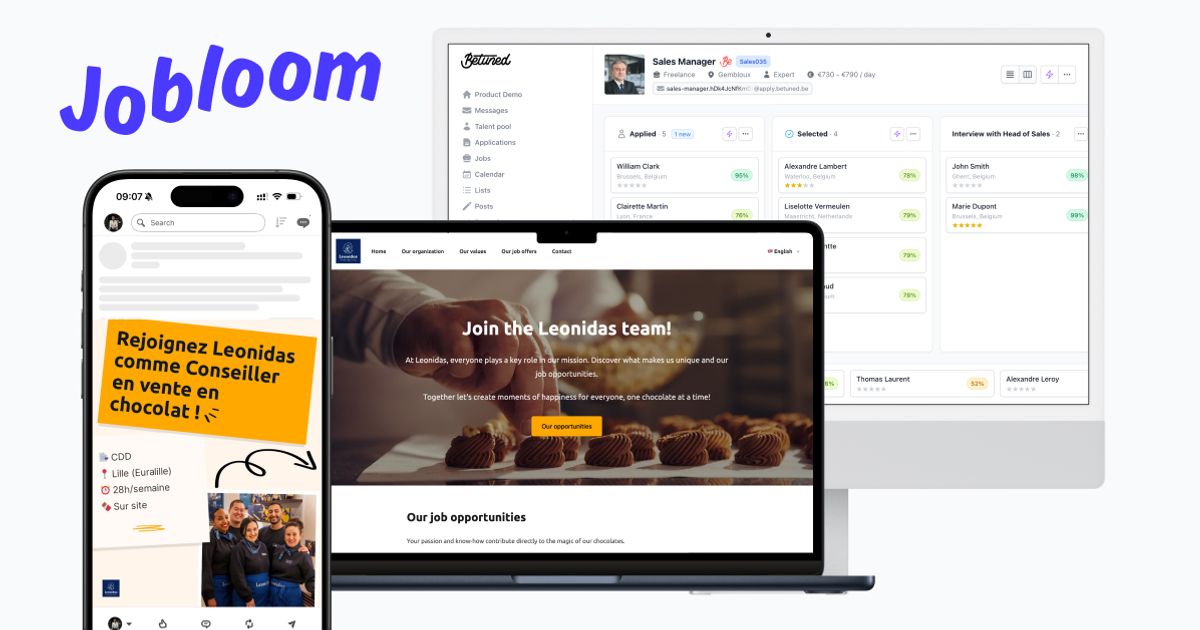
Leonidas: Strengthening the employer brand and recruiting internationallyLeonidas, an iconic Belgian confectionery brand, needed to structure its recruitment in order to meet specific challenges related to its international expansion. By working with Jobloom, the company successfully strengthened its employer brand and attracted qualified talent from across Europe. Discover how we contributed to their success.The challengeInternational recruitmentAttract diverse profiles in different European countries.Lack of visibilityDifficulty effectively promoting job opportunities.Application managementComplex and poorly structured follow-up.The objectivesCreate a careers site to showcase your employer brand and centralize job openings.Implement an efficient ATS to streamline application management.Develop an international recruitment strategytailored to their specific needs.The solution provided by JobloomA tailor-made careers site: A dedicated space presenting Leonidas as an employer of choice, highlighting its values and opportunities.An applicant tracking system (ATS): Centralized and simplified tracking for all job postings across Europe.Visibility optimization: Multi-posting of job ads to maximize their reach on European job boards and social networks.Request a free demo

Comment Huggys a multiplié par 12 son taux de conversion candidat dans l’hospitalité ?
How Huggys multiplied its candidate conversion rate by 12 in the hospitality sectorDiscover how Huggys, a player in the hospitality sector, revolutionized its recruitment thanks to Jobloom. With a 24% conversion rate and 400 resumes received per month, our solution has transformed their HR strategy. -- With high turnover and a lack of digitalization, Huggys, a company specializing in the hospitality sector, was facing major recruitment challenges. By working with Jobloom, Huggys was able to structure and optimize its recruitment process while developing its employer brand. Find out how our solution transformed their HR strategy.The challengeHuggys was facing several obstacles:High turnover: A constant need to recruit new talent.Outdated processes: Lack of appropriate tools and digital solutions.Lack of visibility: An employer brand that is not sufficiently highlighted, making it difficult to attract talent.The objectivesStructure the recruitment processwith a dedicated tool.Create an attractive careers siteto strengthen your employer brand.Improve application managementthanks to an intuitive digital system.The solution provided by JobloomCreation of a customized careers site: Showcasing the Huggys brand to attract talent, with a clear presentation of the company’s values and opportunities.Applicant Tracking System (ATS): Centralized tracking of applications to streamline the selection and hiring of top candidates.Optimization of the recruitment process: Full digitalization for time savings and increased efficiency.The results📌 A conversion rate 12 times higher than average! The average conversion rate for career sites in the hospitality and restaurant industry is around 2% to 3% (source: LinkedIn & Glassdoor). With 24%, Huggys vastly outperforms the market thanks to optimizing its recruitment through Jobloom.Want to transform your recruitment like Huggys?Discover how Jobloom can help you tackle your HR challenges with a tailor-made solution.Request a free demo

Et si vos candidats étaient vos clients les plus précieux ?
#1 Talents = Clients 55 % refusent une offre à cause d’un mauvais processus. 50 % se disent déçus de leur expérience candidat. Pourtant, vous bichonnez vos clients. Pourquoi pas vos talents ?#2 RecruterRecruter, ce n’est plus filtrer. C’est séduire, comme une vraie marque. Les candidats veulent une expérience claire, fluide, engageante.#3 Site carrière personnaliséMobile, fluide, à votre image. Jusqu’à 24 % de conversion.#4 Diffusion sur 100+ plateformes Automatiquement. Google job, Indeed, LinkedIn Recruteur… en un clic.#5 Un ATS boosté à l’IACentralisez vos candidatures, automatisez, gagnez du temps.#6 Le recrutements devient simpleLes bons candidats viennent à vous. Et ils ont envie de rester.#7 Vos candidats ne sont pas des numérosCe sont vos futurs clients internes. Et avec Jobloom, vous les recrutez comme vous vendez.La bonne nouvelle ? Tout ça se corrige facilement.Avec Jobloom, les PME peuvent digitaliser leur recrutement sans perdre leur authenticité et sans se ruiner.Vous avez envie de voir comment ça marche ?
You might also like
I see evolution on one side, potential on the other. And I savor it!
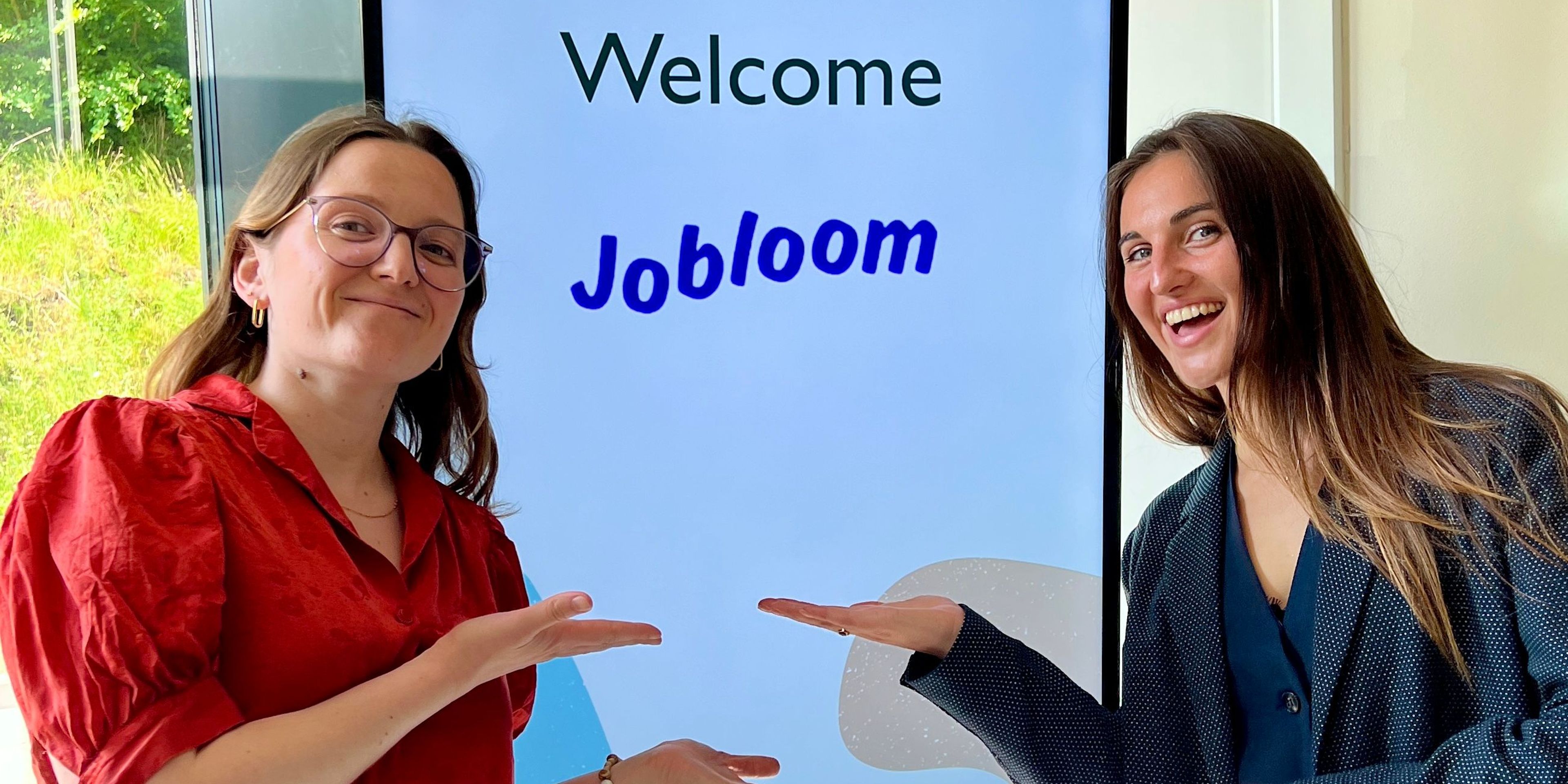
On the left, Charlotte Courtat. She started as a junior recruiter at Betuned. Today, she is Product & Account Manager at Jobloom. Three years of learning, testing, and growing in power. And frankly, what a rise. Bravo, Charlotte! On the right, Romane Willemart. She started this week as a junior in digital communication. She's discovering everything, asking lots of questions, observing… and we already feel that she won't stay in the shadows for long. Welcome, Romane! This kind of photo is more than just a team snapshot. It's a reminder that talent reveals itself with time, trust, and a little space to dare. And me? I'm here, watching it all with a mix of pride, admiration… and a lot of enthusiasm for what's next!Let's Bloom!

Mastering boolean search: your lever to find the best candidates
Switch to proactive sourcing. Our practical guide teaches you how to master Boolean search (AND, OR, "") to uncover hidden talents before your competitors do.Boolean search. This technical term may seem complex or even intimidating at first glance. Many HR professionals hesitate to delve into it.Yet, behind this name lies a candidate sourcing method of formidable efficiency, and much more accessible than it seems. A few minutes of reading will suffice to reveal its fundamental principles and to transform your approach to recruitment.This advanced search technique may seem daunting, but it is an extremely effective solution for identifying qualified profiles on essential platforms like Google or LinkedIn. In a job market where talent is scarce, Boolean search is an often underutilized strategic asset that can give you a head start.Boolean Search: Definition and Fundamental PrincipleBoolean search is a precise search methodology that relies on logical operators (such as AND, OR, NOT) to refine and target the results of a query.→ Its scope is broad: it is just as relevant for finding profiles on Google as it is on professional networks (with LinkedIn being the foremost) or job boards. In summary, whenever there is a search bar, there is a strong likelihood that you can use it to optimize your searches.For instance, to find an experienced front-end developer in Lyon, your Boolean search could be phrased as follows: (front-end developer OR front-end engineer) AND Lyon AND (React OR Angular) AND experience > 5 yearsEssentially, Boolean search gives you the power to construct a structured query to filter out the noise and only surface profiles that very precisely match your criteria.Why Boolean Search is a Strategic Asset in Recruitment?The main advantage of Boolean search in recruitment lies in its ability to streamline and speed up the sourcing process. By using logical operators, recruiters can refine their searches to target only candidates who perfectly match their requirements.👍 Considered an insider's sourcing technique, Boolean search allows for a dramatic time-saving. It automatically filters out irrelevant results, enabling you to focus exclusively on the most promising profiles.Moreover, this method provides unmatched agility and adaptability. Recruiters can adjust and modulate their queries in real time to meet the changing needs of the business or market fluctuations. It is an essential tool for identifying top talent quickly and efficiently.🦾 It is also a skill that few recruiters master perfectly, which gives an undeniable competitive advantage to those who use it.The Essential Boolean Operators to MasterBefore you start hunting for talent on the web, mastering key operators is essential. Here are the most important ones and their practical application:Operator "AND": This operator is used to narrow down a search by requiring the presence of all the specified terms. It is ideal for combining mandatory criteria.Example: For a Digital Project Manager proficient in English and agile tools in Paris: "Digital Project Manager" AND English AND Agile AND Paris.Operator "OR": The "OR" operator is used to broaden a search by including alternatives. The result will display profiles containing either of the terms.Example: For a Data Analyst or a Data Scientist in Lille: ("Data Analyst" OR "Data Scientist") AND Lille.Operator "NOT" (or the "-") sign: This operator is used to exclude specific terms from your results.Example: To find profiles of experienced salespeople, but without juniors or apprentices: B2B Sales AND experienced NOT junior NOT apprentice.Operator "SITE:": Useful for focusing your search on a single website. It must be in lowercase, followed by a colon and the site's URL, without any spaces.Example: To search for "Marketing Directors" exclusively on LinkedIn: site:linkedin.com/in "Marketing Director".Operator "EXT:": This operator allows you to search for specific file types (PDF, DOCX, etc.), very useful for finding resumes online.Example: To find resumes for "Management Controller" in PDF format: CV "Management Controller" ext:pdf.Refine your searches using punctuationBeyond operators, punctuation is your ally for even more surgical queries.Guillemets (" ") : Utilisez-les pour rechercher une expression exacte. La recherche ne remontera que les résultats où les mots apparaissent dans cet ordre précis.Example: "Human Resources Manager" will target this exact position, and not profiles containing "manager" and "human" separately.Parentheses ( ) : They are crucial for grouping terms and controlling the order in which operators are applied, especially when combining AND and OR.Example: For an experienced salesperson in Bordeaux or Toulouse: Sales AND (Bordeaux OR Toulouse) AND experience > 3 years.Asterisk (*) : The asterisk acts as a wildcard that replaces the end of a word. It allows finding all variations from the same root.Example: searching for recrut* may yield results for "recruiter", "recruitment", "recruiter", etc.Putting into Practice: Concrete Example of a Boolean SearchLet's imagine we are looking for a Customer Service Manager for the e-commerce sector in Brussels, who is bilingual.An initial search on Google could be: site:linkedin.com/in ("Customer Service Manager" OR "Head of Customer Service") AND Brussels AND "e-commerce"To further refine and exclude profiles that are too junior or internships, while including Dutch as an alternative to bilingualism, the query becomes: site:linkedin.com/in ("Customer Service Manager" OR "Head of Customer Service") AND Brussels AND ("e-commerce" OR retail) AND (bilingual OR Dutch) -junior -internDo you see the power of the tool? It's the same principle that applies to your personal searches. Next time you're looking for a smartphone, try: smartphone AND "OLED screen" AND (battery life > 24h) -refurbished.5 Practical Tips to Optimize Your Boolean SearchesEliminate broadly: Use the NOT operator (-) from the start to exclude irrelevant profiles (experience levels, sectors, statuses...).Target with precision: Combine AND and OR to identify talents with niche skills or specific combinations of expertise.Combine smartly: Do not hesitate to create complex queries to discover unique profiles that simple searches never reveal.Iterate and refine: Your first query is never the last. Analyze the initial results and adjust your operators to improve relevance.Capitalize on your work: Save your most effective queries in a shared document (such as Excel or Notion). You will save precious time for your future recruitments.ConclusionMastering Boolean search is a fundamental first step in turning your sourcing into a true strategic advantage. It's the art of asking the right questions to search engines to get answers of unmatched relevance.However, finding the best talent does not stop there. To go further and optimize your entire process, from attracting candidates to their integration, it is essential to rely on expertise and appropriate tools.At Jobloom, we help businesses structure and professionalize their hiring processes to attract and retain the best candidates in the market. Ready to make every recruitment a success?Discover how Jobloom can enhance your recruitment strategy.